
From Tech Purchase to Tech Performance
Bridging the Gap with Custom Learning Plans
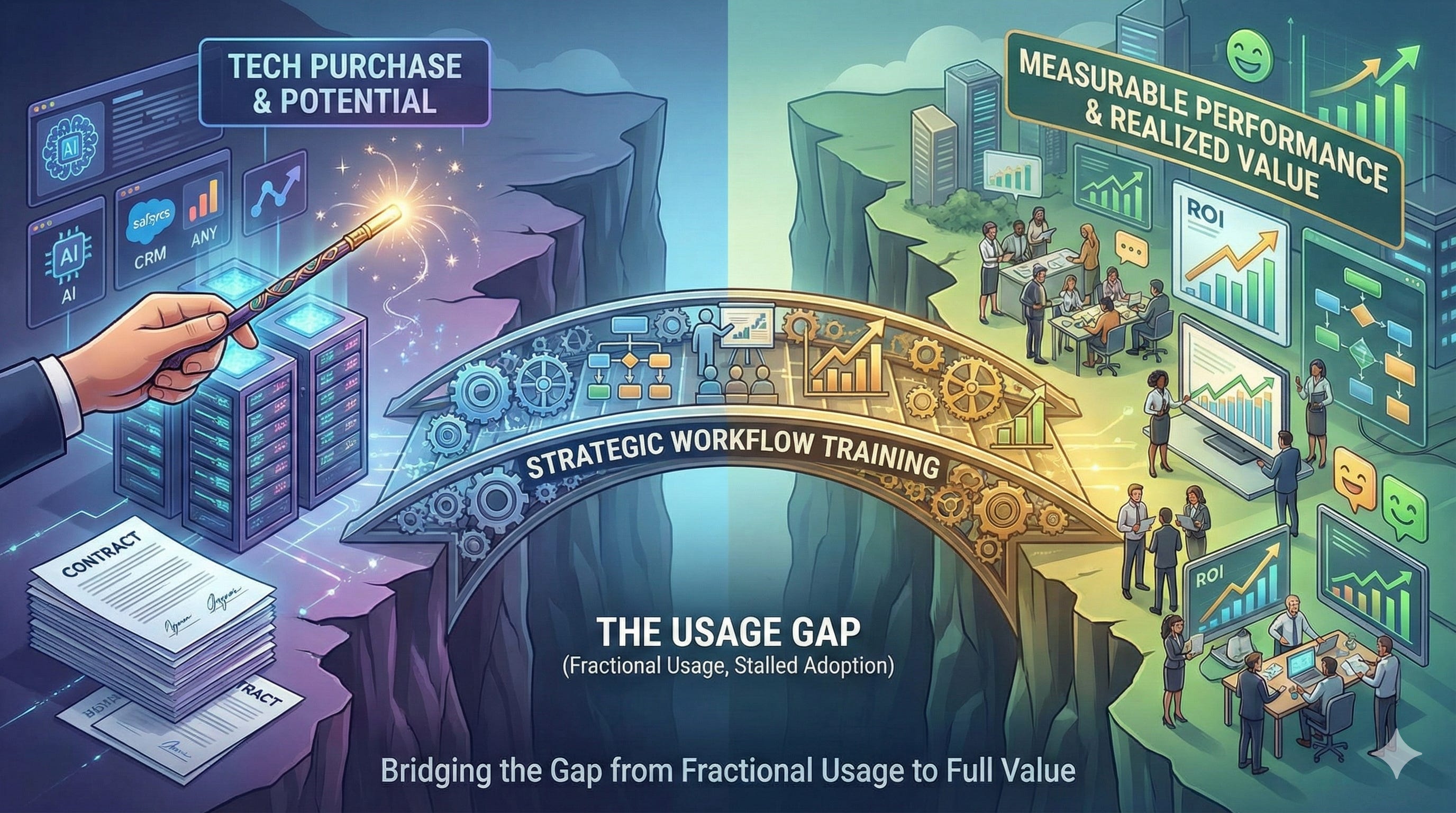
Most organizations don’t have a technology problem. They have a usage problem.
Every year, smart and well resourced companies sign big contracts for powerful platforms such as AI tools, CRMs, analytics suites, and collaboration hubs. The announcements go out, dashboards light up, and everyone feels that meaningful progress has been made.
Then, slowly and quietly, not much changes.
Teams revert to spreadsheets, email threads, and legacy tools. Leaders start asking uncomfortable questions about ROI. Product managers wonder why the platform is not shaping behavior the way it was supposed to. Procurement teams see another line item that is hard to justify during budget season.
This gap between what the technology can do and what the organization actually gets from it is where millions of dollars in value disappear. That value does not disappear because the tools are bad. It disappears because the organization never fully equips its people to use what it already owns.
This is a conversation about training, but not in the sense of checking a box and sending everyone to a single class. It is about treating learning as a strategic lever for turning technology investments into measurable performance.
The Magic Wand Mindset
Underneath a lot of stalled adoption sits a simple and powerful belief: If we buy the right technology, our problems will go away.
You can hear it in the way big purchases are justified:
This platform will finally fix our forecasting issues.
This tool will streamline our sales process.
This system will increase productivity and reduce errors.
There is a subtle but important assumption inside those statements. The act of buying is equated with the act of solving.
This is the magic wand mindset. The contract feels like the wand and the signature feels like the spell. Once it is done, everyone breathes easier. The problem feels handled. The organization mentally moves the issue from in progress to resolved, even though nothing has actually changed in day to day behavior.
Purchasing technology is not the same as realizing value from it. What you have really bought is potential, not performance.
It is like parking a Ferrari in the driveway but never learning to drive it properly. Or investing in a top tier treadmill, placing it in the spare room, and declaring that you are a healthier person even though your routine has not changed.
For product managers, procurement professionals, and executives, this distinction is vital. If your internal story ends at choosing and acquiring the right tool, the organization is structurally set up to underinvest in the part that matters most. That part is how people will actually use it.
The mindset shift is straightforward but profound. Signing the contract is not the finish line. It is the starting line.
The Cost of Fractional Usage
Once the magic wand moment passes, the pattern inside many organizations is remarkably consistent.
The tool is deployed. Accounts are provisioned. Login instructions go out. There might be a launch webinar and a PDF or two. Everyone nods, the emails are filed away, and the platform quietly becomes another part of the tech stack.
Then daily reality hits. People are busy. They are measured on outputs and deadlines, not on mastering new systems. So they do what humans naturally do. They default to what they already know.
Instead of a bold leap into new workflows, you get something much smaller. You get fractional usage.
Picture paying for an all you can eat gourmet buffet with prime rib, fresh seafood, custom omelets, and a dessert station. You walk in, grab a single crouton from the salad bar, eat it, and walk out. On the way home, you complain that the restaurant was not worth the price.
That is what fractional usage looks like with technology:
You pay for the full platform, including advanced features, automation, integrations, and analytics.
Most users learn only the bare minimum, such as how to log in and complete one or two basic tasks.
The majority of the capability sits untouched month after month.
From a financial perspective, this is harsh. Licenses are not billed based on what percentage of features you use. You pay for one hundred percent of the capability whether you use it or not. If the organization is only tapping ten to twenty percent of that potential, the remaining eighty to ninety percent is effectively waste.
The dangerous part is that this waste is invisible.
You cannot see unused software stacked in a storage room. There is no physical reminder that most of what you bought is untouched. It only shows up indirectly through sluggish performance improvement, underwhelming adoption metrics, and a growing sense that you are not getting what you paid for.
If you bought one hundred tons of steel and used only ten, leaving the rest to rust outside, everyone would recognize the problem immediately. Yet the same thing happens quietly with technology. Fractional usage becomes normalized as an unfortunate but inevitable reality.
It does not have to be that way.
When Adoption Stalls, ROI Flatlines
Fractional usage is not just a static inefficiency. It actively erodes your competitive position over time.
The trajectory usually looks like this:
Launch enthusiasm: Early on, curiosity and leadership attention drive logins. People explore the platform a bit, attend initial sessions, and test a few features.
Friction and confusion: Users hit complexity. Workflows do not quite match their real tasks. The benefits feel vague. What they could do with the tool is not obvious in the context of today’s deadlines.
Quiet retreat to old habits: Because the old way is familiar and predictable, people drift back to spreadsheets, email threads, and legacy tools. The new platform becomes something they open only when asked.
Compliance without commitment: Leadership sees adoption metrics lagging and starts pushing reminders or even mandates. Users comply just enough to satisfy tracking, but the tool never becomes the way work is actually done.
Flatlined ROI: The technology shows up in financial reports but not in performance improvements. It sits as dead weight on the balance sheet, an asset on paper but not in practice.
Flatline is an important metaphor. It suggests not just underperformance, but a complete lack of pulse. While this is happening, your competitors may be using similar tools in very different ways. They are building automations, streamlining workflows, and turning the same capabilities into a real advantage.
In that context, stalled adoption is not neutral. It is a drag. The gap between what is possible and what is realized grows wider each quarter.
For decision makers, this is when hard questions surface. Did we choose the wrong platform? Did we overbuy? Do we need yet another tool to fix what this one did not solve?
Often the answer is not “wrong platform.” It is “right platform, underpowered by training.”
Why Quick Fix Training Fails
Most organizations do not ignore training. They tend to treat it as a quick fix.
The default pattern looks something like this:
A vendor webinar that walks through features
A recorded demo
A slide deck or help center article
One or two optional office hours sessions
These are not automatically bad. They are simply incomplete.
They share a common focus. They explain what the tool does in terms of buttons, menus, screens, and possibilities, without truly anchoring it in how people work day to day.
Feature focused training sounds like this:
Here is how you create a new record.
This is where you build a dashboard.
This menu gives you various automation options.
The underlying expectation is that users will map those features to their own workflows on their own time. In reality, that rarely happens. Not because people do not care, but because they are pressed for time and mental bandwidth, the risk of getting stuck feels higher than the perceived benefit, and they are not being measured or rewarded for exploring the full feature set.
When training is treated as a one time event, it becomes something to get through, not a mechanism to transform how work is done. The outcome is predictable. Most users operate at the shallow end of the pool and stay there.
If you are responsible for product success, procurement value, or strategic performance, this is the moment to pause. The problem is not a lack of training activity. It is a lack of strategic learning design that is aimed squarely at business outcomes.
Training As a Strategic Bridge
If the real value of your technology lives in how people use it, then training is not a support afterthought. It is the bridge between procurement and performance.
That bridge is not built from generic courses or one size fits all sessions. It is built from custom learning plans that are directly aligned with your organization’s goals, workflows, and culture.
A strategic learning plan starts with different questions:
What business outcomes do we actually expect from this tool?Faster sales cycles, fewer errors, better forecasting, higher customer satisfaction.
Which workflows, if improved, would have the greatest impact on those outcomes?
Who needs to do what differently on Monday morning for those improvements to appear?
Only after those questions are clear does it make sense to design the learning experience.
Instead of thinking you must train everyone on all the features, a strategic approach sounds more like this:
Let us redesign how opportunity handoffs happen between sales and customer success, and build training around that.
Let us shorten the month end reporting process from three days to one, and teach people exactly how to use the tool to do that.
Let us reduce errors in order entry by thirty percent, and train to the specific behaviors and checks that make that possible.
Training in this model is less about abstract knowledge of the tool and more about confidence and competence in key workflows that drive results.
This is where custom learning plans are especially powerful. They connect your business drivers, your existing processes, your chosen technology, and your people’s current skills and capacity into a coherent path from “we bought this” to “we are benefiting from this.”
Workflow First Learning Unlocks Value
The most effective training programs share one critical trait. They are unapologetically workflow first.
A workflow first learning plan does not start with menus and modules. It starts with the real work your people already do:
The weekly report that everyone dreads
The customer follow up that often falls through the cracks
The approval process that gets bogged down in email
The handoff that regularly causes confusion and rework
From there, the plan zooms in on how the technology changes that experience:
Which steps disappear
Where automation reduces manual effort
What data becomes visible that was hidden before
How risk is reduced or quality is improved
Training becomes very tangible:
Here is how to turn that Friday report from a two hour chore into a five minute task using this specific workflow in the system.
Here is the exact way to log and track customer follow ups so nothing is missed again.
Here is how approvers can review and decide on requests in one place instead of sorting through their inbox.
People do not have to imagine the value. They experience it, inside the tools they have already been given, using their own data and tasks.
Once someone directly experiences a meaningful improvement in their own work, their relationship with the tool changes. It stops being the new system they are supposed to use and becomes the way they get their work done better.
That shift, from obligation to ownership, is where adoption stops being a push and starts becoming a pull.
Making Training a Priority, Not an Afterthought
For organizations, the question is not whether training matters. The question is where it sits in the priority list.
If training is treated as a late stage checkbox, something to rush through after the tool is selected, contracted, and deployed, you will almost always end up with fractional usage and flatlined ROI.
When training is treated as a strategic investment and planned alongside the technology itself, everything changes:
Procurement decisions are made with usage in mind, not just features and price.
Product rollout plans include learning as a core pillar, not a side activity.
Executives can tie training initiatives directly to KPIs and business outcomes.
Teams see that the organization is serious about helping them succeed, not just handing them new tools and hoping for the best.
This does not mean you need an endless series of workshops. It means you need thoughtful, purpose built learning plans that start with business goals, focus on high impact workflows, respect how adults actually learn and adopt new behaviors, and evolve over time as the organization matures in its use of the technology.
The payoff is more than getting your money’s worth from one platform. It is building a culture where new tools are consistently translated into new capabilities, where learning is the engine that turns potential into performance.
If you are looking at your tech stack and suspect you are getting crouton value from full spread investments, you are not alone. The good news is that this is a solvable problem if you are willing to treat training as the strategic bridge it truly is.
Ready to move beyond fractional usage and start turning potential into real performance, visit https://www.client-informatics.com/training to learn more and schedule a call.