
Turning Tool Confusion into Confident Execution
A Guide for Leaders
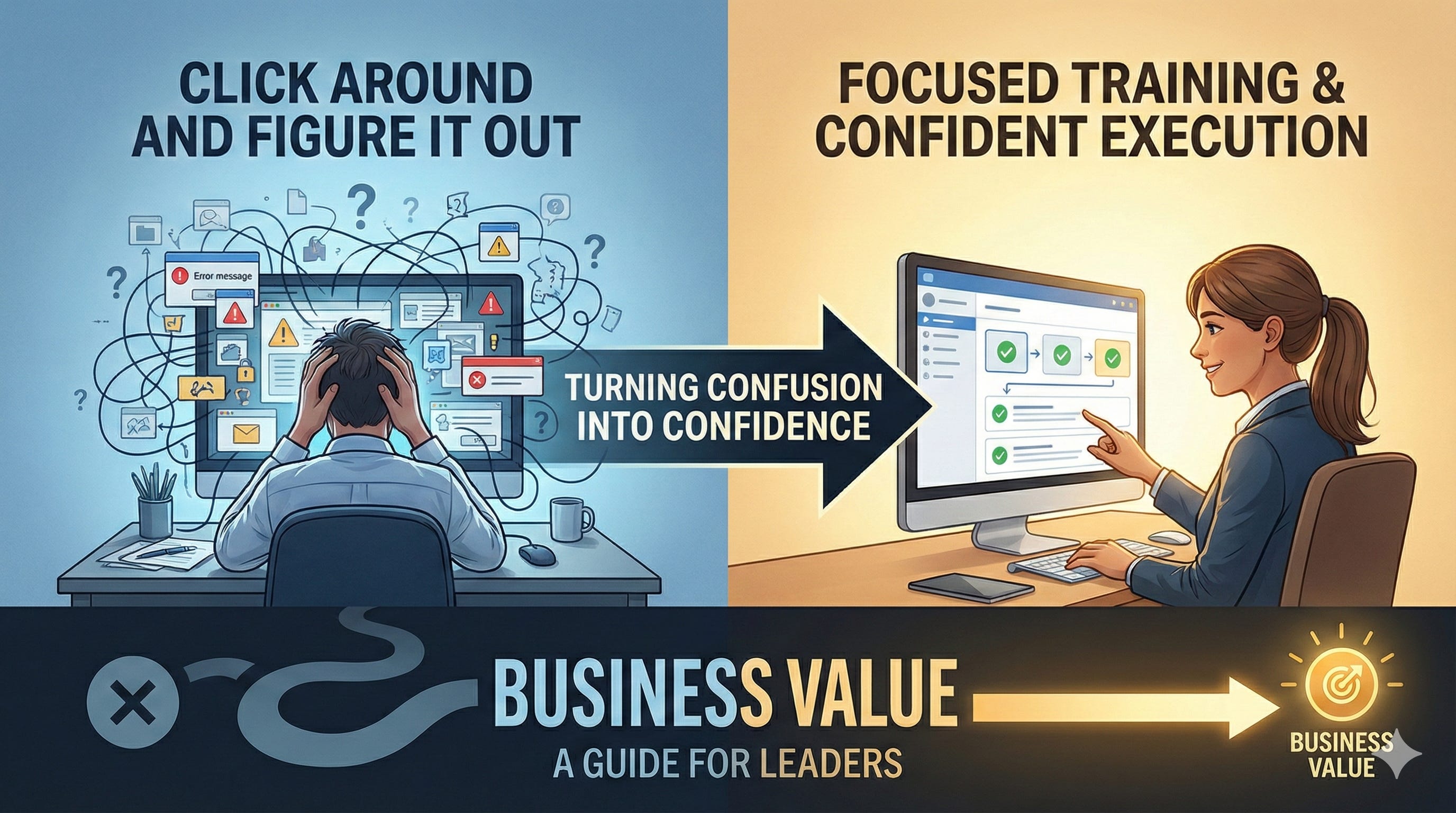
Imagine this all too familiar Monday morning scene. Your team has been buzzing about the new software platform for weeks. Emails from leadership promised a game-changer, dashboards gleam with promise, and everyone is eager to dive in. You log in with your coffee in hand, ready to hit the ground running. Instead, you face a sleek interface that feels like the cockpit of a spaceship. Buttons everywhere, menus that seem to lead nowhere familiar, and no clear path to the tasks you need to accomplish. What now? Most teams resort to the default strategy “click around and figure it out.”
If you are a product manager, procurement professional, or executive decision maker, this moment is not just inconvenient. It is a silent productivity killer that threatens your budgets, timelines, and team morale. Casual readers might recognize it from their own experiences with new apps or gadgets, but in a business context, the stakes skyrocket. This post explores why that initial confusion persists, the real costs it imposes, and how prioritizing thoughtful training can transform it into smooth, confident execution. We will lay the groundwork for understanding why training deserves a front-row seat in your tech investment strategy, not as a nice-to-have add-on, but as a core driver of business value.
The Hidden Cost of “Click Around and Figure It Out”
We have all done it. A new tool lands on our desk, and we start exploring intuitively, much like we do with consumer apps such as Instagram or Spotify. There, the risks are low, maybe you accidentally like an old photo or skip the wrong playlist. No real harm done. But enterprise software operates in a different world. These platforms power critical workflows, handle sensitive data, and support high-stakes decisions. Leaving teams to click around under deadline pressure is not a learning method, it is a gamble with your organization’s performance.
Think about the environment. Consumer tech thrives on discoverability because failure costs nothing. In your world, though, every misclick in an ERP system, CRM, or project management tool ripples outward. Deadlines loom, budgets tighten, and expectations mount. Product managers know this erodes feature adoption rates. Procurement pros see it inflate total cost of ownership. Executives watch it undermine ROI on multimillion-dollar investments. This gap between rollout hype and actual productivity is one of the most underestimated risks in modern projects.
Three consequences stand out, each more damaging than the last.
First, projects slow to a crawl. It might seem minor at first, a team member spends 30 minutes hunting for a file or guessing how to generate a report. Multiply that by 10 people across a week, and you have lost dozens of productive hours. Worse, it shatters flow states. Every interruption for interface wrestling pulls people out of deep work, forcing constant context switches. Your Gantt charts glow green, but underneath, the team treads water just to keep up with basic navigation. Momentum vanishes, turning aggressive timelines into endless slogs.
Second, errors creep in, creating what experts call “phantom work.” Users guess their way through, “This looks like the right field” or “I think this submits the form.” The result? Rework piles up, data fixes, reconciliations, and investigations that eat time no one budgeted for. Consider a classic CRM mishap, someone aims to update shipping addresses but accidentally overwrites billing contacts. Invoices bounce for weeks before anyone notices. These are not typos, they corrupt the business logic leaders depend on for strategy. Procurement teams that focused on license costs miss how bad data inflates ongoing expenses. Product managers see skewed usage metrics. Executives make flawed decisions on faulty inputs. Suddenly, that shiny tool becomes a liability.
Third, and perhaps most insidious, quiet frustration builds. We hire smart, competent people for their expertise. When they stumble over a new tool, self-blame kicks in fast. Imposter syndrome whispers, “Everyone else gets it, I must be the issue.” They suffer in silence, avoiding questions that might paint them as incompetent. This internal stress simmers, then redirects outward, first to the tool (”This software is broken”), then to the leaders who chose it (”Why did they pick this garbage?”).
Adoption craters. Shadow IT takes over, hidden spreadsheets, email chains with attachments, personal workarounds. The tech purchase, meant to streamline operations, sits unused. Teams feel ignored, trust erodes, and resentment festers quietly. For product managers, it means low engagement with your features. Procurement sees wasted spend. Executives face stalled transformation initiatives. Even casual readers can relate, it is like buying a high-end kitchen gadget, struggling to use it, and reverting to takeout.
Shifting to Confident Execution Through Focused Training
The good news? You can flip this script. The path forward is not dumping more PDFs or generic webinars on your team. Those fire-hose sessions overwhelm with every feature under the sun, regardless of role relevance. Retention tanks, and confusion lingers. Instead, embrace focused product training, role-based, workflow-driven guidance that connects the tool directly to daily work.
Picture teaching piano. The unfocused way means weeks on hammer mechanics and history, leaving the learner bored and unable to play a note. The focused way provides specific instruction, place fingers on keys, guide them through a simple song, and watch confidence bloom. Now apply that to your project management tool. Skip the admin backend tour. Instead, walk a project manager through creating a project, assigning tasks, and tracking timelines, exactly what they do every day.
This answers the real question burning in users’ minds, “How do I do my job here?” Not “What is every bell and whistle?” When training aligns with workflows, the tool fades into the background. Users stop fighting buttons and start executing. Flow returns. That cockpit dashboard? It becomes intuitive for the routes that matter.
Managers notice the change in subtle but powerful ways. Both confused teams and confident ones work in silence, but the quality differs sharply. Confusion breeds silent fear, confidence delivers focus. Predictability reemerges and product managers track genuine adoption. Procurement justifies spends with hard metrics. Executives see projects hit milestones.
Morale rebounds too. Quiet frustration flips to empowerment. Leaders signal, “I am investing in your success with this tool.” People want to excel, give them the keys, and they drive. This is not quick-fix training. It starts with understanding your business drivers, diagnosing specific pain points, and crafting plans that maximize your tech stack’s value.
Why Training Belongs in Your Core Strategy
Leaders face a clear fork in the road:
Option 1: Default to “figure it out,” inviting delays, errors, and resentment.
Option 2: Prioritize focused training upfront, securing execution, accuracy, and buy-in.
Too many skip it, viewing training as an afterthought once the enterprise license is signed. That logic crumbles under scrutiny. The costs of confusion dwarf training budgets many times over.
Recall the project triangle of scope, time, cost. External chaos abounds, market shifts, client demands, unforeseen absences. User adoption? That is yours to control. Treat it as a risk like any other. Product managers can bake it into roadmaps. Procurement can negotiate training in vendor deals. Executives can mandate it for approvals. Casual readers, think of it like buying a car, the sticker price matters, but so does learning to handle its power safely.
Building custom learning plans elevates this further. It is not about off-the-shelf classes. It involves consulting to uncover needs:
What workflows hurt most?
Which features drive revenue?
How does this tech align with goals?
The output includes tailored plans that turn purchases into performance. Organizations gain more from what they already own, without constant new buys.
Consider scale. A mid-sized firm rolls out a new CRM. Without guidance, low adoption after six months is common. With focused training, adoption jumps significantly, slashing support tickets and boosting output. Procurement ROI calculators light up. Product managers refine based on real feedback. Executives report transformation success.
This groundwork matters because tech alone does not deliver. People do. Prioritizing training closes the confidence gap, stabilizes operations, and frees leaders to focus on growth. It is an investment in human capital that pays dividends in efficiency and loyalty.
Making the Business Case Step by Step
To ground this in action, here is how to build the case internally.
Start with data. Audit current rollouts, track time lost to tool confusion via support logs or surveys. Quantify phantom work hours. Product managers have analytics, use them.
Map to outcomes. Link training to KPIs for faster project velocity for PMs, cleaner data for decisions, lower TCO for procurement. Executives love numbers, “Training costs $50K; saves $500K in delays.”
Engage stakeholders early. Procurement folds training into RFPs. Product teams iterate features with trained user input. Run small pilot teams in focused sessions to get measure before/after gains.
Scale thoughtfully. Custom plans shine here. Begin with discovery, interviews reveal blockers like “invoicing workflows stump us.” Build modular paths, core skills first, advanced later. Reinforce with job aids, not manuals.
Measure relentlessly. Adoption rates, error reductions, Net Promoter Scores. Celebrate wins, “Our team cut report generation from 45 minutes to 5.”
This approach resonates across roles. Procurement pros secure better deals. Product managers validate builds. Executives drive enterprise value. Even casual readers see the parallel, it is like gym training before a marathon, not winging it on race day.
Real-world parallels abound. Think Salesforce implementations, generic onboarding yields 30% usage. Tailored plans hit 70%, per industry benchmarks. Or Microsoft Teams rollouts, confusion breeds email relapse, focused sessions lock in collaboration.
For global teams, cultural nuances matter. Custom discovery uncovers them, remote workers need screen-sharing emphasis, field reps prioritize mobile paths.
Long-term, this builds learning cultures. Teams adapt faster to future tools. Turnover drops as competence grows. Procurement budgets stretch further. Product roadmaps sharpen.
Turning tech confusion into confident execution stabilizes your operations and amplifies every dollar spent. It moves projects from chaos to control, empowering teams to deliver.
Visit https://www.client-informatics.com/training to learn more and schedule a call.