
Why Product Training Is Your Strategic Imperative
Turning Tech Investments Into Real-World Performance
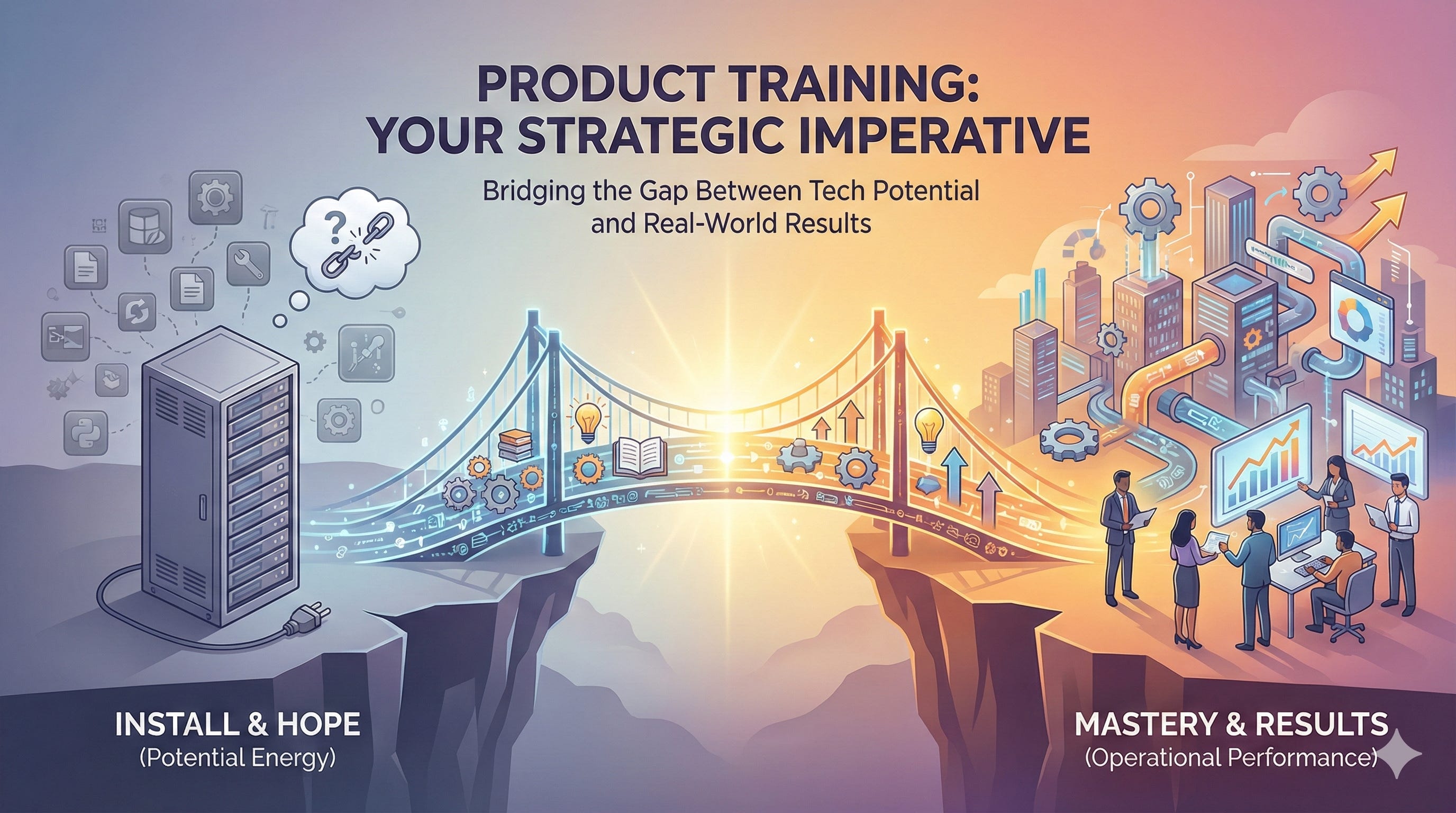
Most teams are not struggling because they bought the wrong tools. They are struggling because they never built the skills, habits, and shared understanding needed to turn those tools into results.
If you are a product manager, procurement leader, or executive decision maker, you have probably seen this pattern more than once. The business case for a new platform looks strong. The demos are impressive. The contract is signed. Months later, the dashboards are half-used, adoption is patchy, and your people quietly drift back to spreadsheets, email, and side channels. On paper, the tech stack looks modern. In practice, the organization is still running on workarounds.
This is not a technology problem. It is a capability problem. And that is why product training is no longer a “nice to have.” It is a strategic imperative.
The Hidden Cost Of “Install And Hope”
Many organizations unconsciously treat implementation as the finish line. The software is deployed, the SSO is wired in, a launch email goes out, maybe there is a webinar or a quick lunch session, and then everyone hopes usage will take care of itself.
Behind that hope sit two risky assumptions:
The software is intuitive enough that most people can figure it out on their own
People will naturally abandon old habits in favor of the new way of working
Consumer apps encourage this belief. You download a to-do list app or a game and you rarely need training. Enterprise tools are different. They live inside complex ecosystems that must honor security policies, compliance rules, cross-functional handoffs, approvals, and data models. They are not just individual tools. They are part of your operating system.
Knowing which button to click is the easy part. The hard part is knowing why a particular field must be filled in a particular way, how that data flows to another team, and what happens when someone decides to skip a step.
When that context is missing, people do what humans have always done. They protect their local efficiency, even if it hurts the system as a whole.
Life Inside “The Gap”
Between signing the contract and realizing the business benefits, there is a dangerous middle zone. You can think of it as “the gap” between installation and mastery. On the surface, everything looks fine. The tool is live. The licenses are active. The icons sit on everyone’s desktop.
Underneath, three things tend to happen.
First, productivity starts to leak away in small, almost invisible ways. An engineer cannot find the latest requirements in the new system and pings someone for the file. A sales rep struggles with the CRM workflow and builds a personal spreadsheet instead. A support agent is confused by the new knowledge base and relies on direct messages to colleagues. Each instance is minor. At scale, these leaks add up to hours of lost time and a steady drift away from the system of record.
Second, projects begin to slip. Work is happening, but not where you think it is. The new ticketing or project system shows partial information because issues are getting handled in chats, email threads, or unofficial trackers. Status reports become less reliable. Dependencies get missed. Leaders are managing through fog, not through clean data.
Third, the ROI that justified the investment quietly erodes. Forecasts assumed a certain level of adoption and proficiency. In reality, you have partial adoption and inconsistent use. The organization is paying both for the platform and for the friction people experience when they must fight the tool or work around it. Nobody sends a memo announcing that ROI has evaporated. It simply never fully appears.
For product managers, this gap looks like disappointing engagement metrics and underused features. For procurement, it looks like shelfware and renewal anxiety. For executives, it looks like stalled transformation and unclear payback.
Why Training Is A Strategy, Not A Checkbox
When people hear “training,” they often picture a once-a-year workshop or a set of onboarding videos. That mental model is far too small for the stakes involved.
Think about your last major tech purchase. You did not buy a CRM, ERP, or analytics platform just to have a new interface. You bought it to achieve outcomes like higher retention, faster decision making, better compliance, or shorter response times. In that sense:
If you bought a CRM to improve customer retention, CRM mastery is part of your retention strategy
If you bought analytics tools to speed up decision making, analytics skills are part of your decision strategy
If you bought a service platform to improve customer experience, agent proficiency is part of your customer experience strategy
The software itself is potential energy. Training is the wiring that connects that potential to real work. Without that wiring, the system sits in the environment without meaningfully changing behavior or outcomes.
This is why cutting training budgets to “save” money on a project is so risky. It reduces the only investment aimed at turning a capital expense into operational performance.
What Mastery Actually Looks Like
It is tempting to define success as “everyone can log in and complete the basic tasks.” That is the floor, not the ceiling.
Real mastery shows up differently:
People can explain not just what to do, but why the process matters
Data quality improves, because users understand the downstream impacts of their inputs
Handoffs feel smoother, because teams share a common mental model of how work flows through the stack
Leaders can trust the reports and dashboards, because the underlying usage patterns are consistent
You can hear the difference in day-to-day conversations. Instead of “How do I get around this field” you hear “If we skip this step, finance cannot reconcile this later” or “If we do not tag this correctly, support will not see it in time.”
At that point, the tool is no longer just software. It is part of how the organization thinks.
Why One-Off Training Events Fail You
Most organizations have experienced some version of the classic pattern. A big launch is followed by an all-day training session. Everyone receives a dense slide deck. There may be a recording. The assumption is that this single moment will carry people through the next year or more of using the tool.
The science of learning points to a different reality. People forget most of what they are exposed to if they do not use it soon and often. Complex workflows cannot be internalized in a single sitting. Skills that are not practiced decay quickly.
Short, isolated events naturally produce shallow familiarity. They rarely produce confident, adaptable users who can handle real-world edge cases under pressure.
Instead of thinking in terms of events, it is more useful to think in terms of learning journeys. A learning journey is not about flooding people with information at once. It is about gradually building confidence and capability through:
Targeted sessions focused on real tasks and scenarios
Spaced reinforcement so concepts resurface over time
Hands-on practice inside the actual tools and workflows
Follow-up support and coaching to handle exceptions and refine habits
This approach respects how adults actually learn. It also respects how organizations actually change, which is rarely in one dramatic moment and more often through repeated, reinforced steps.
Training As Change Management
Even with a well-designed learning journey, one question often surfaces Can training fix resistance to change Or fix a tool that people genuinely dislike
Training cannot turn a fundamentally misaligned or defective product into a good one. If the tool does not meet the needs of the business, even perfect training will not rescue it.
However, many tools that are labeled “bad” are actually misunderstood, badly introduced, or only partially configured for the way people really work. In those cases, training plays a crucial role in change management.
Good training does more than explain buttons. It:
Connects the new way of working to outcomes people care about
Makes tradeoffs visible and explicit rather than leaving them implied
Gives people space to practice and make mistakes safely
Shows concrete benefits such as fewer manual steps, less rework, or more predictable days
When people understand how a system helps them succeed and feel supported in learning it, their resistance often shifts from blanket skepticism to specific, solvable concerns.
Seeing Training As An Investment, Not A Cost
From a budget perspective, training is sometimes treated as a soft cost that can be trimmed. The software contract is hard and very visible. The learning plan is negotiable and sometimes sacrificed to meet short-term financial targets.
If you are in product, procurement, or the C suite, it can help to reframe the question. Instead of asking “How much does training cost” ask:
What is the cost of partial adoption
What does it cost when teams maintain shadow systems outside the tools we bought
How much value do we lose when leaders cannot trust the data because usage is inconsistent
When you view training as the bridge between an approved business case and the reality of everyday work, it becomes clear that underfunding that bridge is a form of risk. It is not just a missed opportunity. It is an active contributor to wasted spend.
Laying The Groundwork For Better Decisions
None of this is about quick fixes or miracle workshops. The point is to build a shared understanding at the decision-making level. Before the next major technology purchase or renewal, the conversation should include more than features and price.
Questions that deserve a seat at the table include:
What behaviors and outcomes do we need this tool to change or enable
What does mastery look like for the roles that will use it most
How will we support people over time rather than just at launch
How will we know if our organization is truly using this tool well
When those questions are asked early, training stops being an afterthought and starts being designed as part of the initiative from the beginning. That is where custom learning plans, role-based pathways, and workflow-aware enablement can make an outsized difference.
You are not just finding people a class to take. You are designing a path that aligns the tool, the work, and the outcomes.
Turn your tech purchases into measurable performance, visit https://www.client-informatics.com/training to learn more and schedule a call.